By Chad Litteken | Litteken Plumbing
Table of Contents
Key Takeaways
- Public sewer standards treat camera footage as required proof of a line’s condition, so a residential inspection delivers the same kind of evidence before any repair is quoted.
- Camera work converts vague symptoms such as slow drains, odors, or a soggy yard into a documented pipe condition, so the repair you buy matches the defect that is actually in the line.
- Ask for both the footage and a written report, because the coded findings are what make the diagnosis useful when you plan cleaning, a localized repair, or replacement.
- Repeating clogs, gurgling drains, sewer odor, and a wet or unusually green strip of lawn point to a condition inside the pipe rather than a one time blockage.
What a Drain Camera Inspection Service Does
A drain camera inspection service is a plumbing diagnosis step that pushes a waterproof camera on a flexible push rod through a sewer, storm, or house drain line and records what the pipe interior shows, so the cause ends up on film before any repair is quoted. Municipal engineers use the same method, and the recording turns a guess about a blocked line into documented evidence. Newfoundland and Labrador’s specification covers inspection of new and existing sanitary and storm sewers by closed-circuit television. Slow drains, frequent clogs, odors, or a soggy yard are the symptoms that usually lead here. Litteken Plumbing records the line, names the cause, and a homeowner can reach the licensed team to schedule service.
Why Does a Camera Inspection Matter?
A camera inspection pushes a waterproof camera on a flexible cable through your main drain or sewer line and shows you the inside of the pipe on a monitor. It matters because it replaces guesswork with visible evidence before anyone digs.
Slow drains, recurring clogs, odors, and a soggy yard tell you something is wrong. They do not tell you what. A clog deep in the line can look the same at the cleanout as a broken pipe or a root mass, and each one calls for a different repair. With the camera in the pipe, the operator can record structural and service defects and judge how clean the line actually is, which is how public-works master construction specifications define the job.
The written report is what gives the footage weight. The National Association of Sewer Service Companies, NASSCO, peer-reviewed its CCTV pipe-condition specification after a member committee drafted it, so findings arrive as documentation rather than a description. That record also answers the next question: whether the line needs cleaning, a localized repair, or replacement.
At Litteken Plumbing, video and camera services sit alongside the rest of our plumbing work, so the diagnosis and the repair plan come from the same licensed crew. Ask to see the footage and keep the written findings. A clear look at what is inside the pipe saves you from paying for the wrong repair.
What Signs Point To A Real Drain Problem?
Start with what you can check yourself: how fast standing water clears, what you smell near a drain or cleanout, and how the lawn over the sewer run looks. Slow drainage that returns in the same fixture, gurgling from a second drain when the first one runs, raw sewer odor, repeat clogs, and a soggy or noticeably greener strip of grass are the reports we hear most. At Litteken Plumbing we work in Madison County, St. Clair County, and Monroe County, Illinois, and those same complaints show up across all three. A drain inspection with a camera turns a symptom into a known condition instead of a guess. One government sewer construction specification frames the purpose as assessing thoroughness of cleaning and then observing and recording structural and service defects. That is a fair summary of a residential scope too. The line has to be clean enough to see inside before the cause is readable.
Why Does The Same Drain Clog Twice?
A clog that comes back in the same place is the clearest sign that the problem is the pipe, not what went down it. Roots are one cause we find often. A tree or shrub sends feeder roots toward a joint or a hairline crack seeking water and nutrients, and once they are inside, the root mass catches paper and grease on every pass. Offset joints from shifting soil leave a ledge inside the crown where debris snags and the opening narrows. A belly, a low section that holds water instead of letting it run, keeps sediment parked in one spot for years. Corroded cast iron does the same thing from the inside out, trading a full bore for a rusted ring until a normal load is too much. In kitchens and commercial food lines, grease and sludge coat the wall as warm discharge cools, so the passage shrinks slowly and every drain in the building starts to feel it.
How Do You Check Before You Dig?
Run the camera before anyone points a shovel at your yard. When you work with Litteken Plumbing, a licensed professional clears or jets the line first so the wall is readable, then feeds the camera from the cleanout or the main access and reads the pipe as it goes, logging how far each defect sits from the point of entry. Ask for that record in writing: the footage, a note at each problem, and the condition described in a consistent format rather than a verbal summary. The National Association of Sewer Service Companies published a pipe condition assessment guideline for exactly this kind of CCTV work. Two limits are worth knowing up front. The camera cannot pass a section that is fully blocked or collapsed, and standing water or heavy sludge makes what you see harder to read. A scope that stops short of the trouble spot still tells you something, but it is a partial picture, and a partial picture is not a reason to start digging.
- Standing water in a sink, tub, or shower that takes more than a few seconds to clear.
- Gurgling from another drain when one fixture runs, which can mean the main line is restricted.
- Raw sewer smell near an indoor floor drain, a cleanout plug, or a cap out in the yard.
- The same fixture clogging again within a few weeks of being cleared.
- A soggy, sunken, or greener than the rest patch of grass along the sewer route.
- Two or more fixtures backing up at once, or sewage returning through the lowest drain.
Symptom versus cause
- Clearing a drain restores flow. Looking inside the line tells you why the flow was restricted in the first place.
- Rule of thumb we use: two callbacks on the same line usually mean a condition in the pipe, not a one time clog.
- Write down which fixtures are slow, when odor shows up, and where the wet spot in the yard is. That notes list is what a licensed tech starts from before the camera goes in.
Quick Facts
- 3 – Illinois counties we serve (Madison, St. Clair, Monroe)
- 25+ years – Combined team experience, Litteken Plumbing
- #055-043593 – License number on file
- 3 years – Operator recertification window in one municipal CCTV spec
How Does a Camera See Inside Your Pipes?
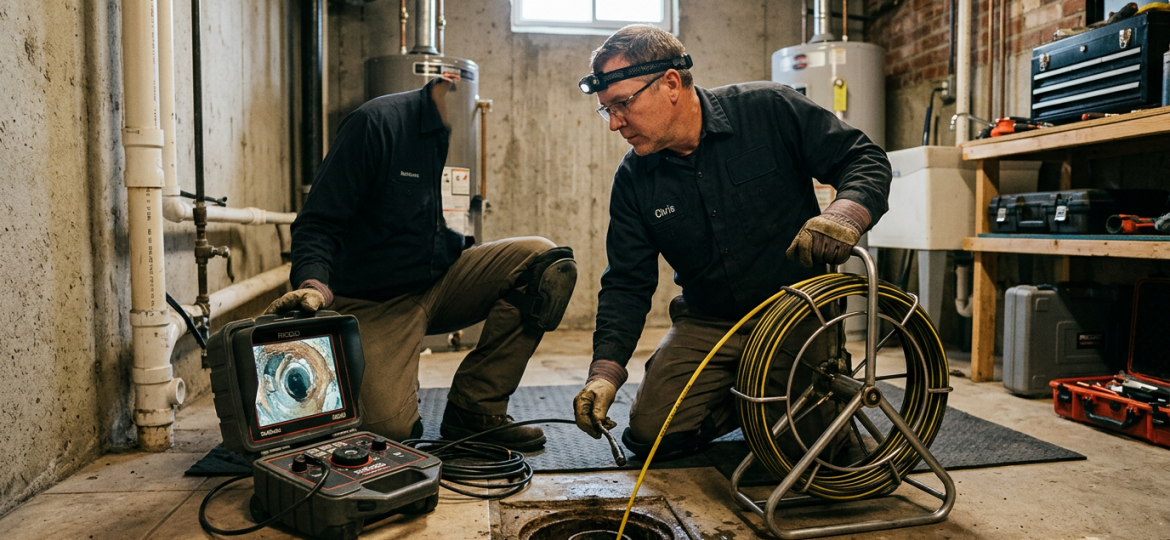
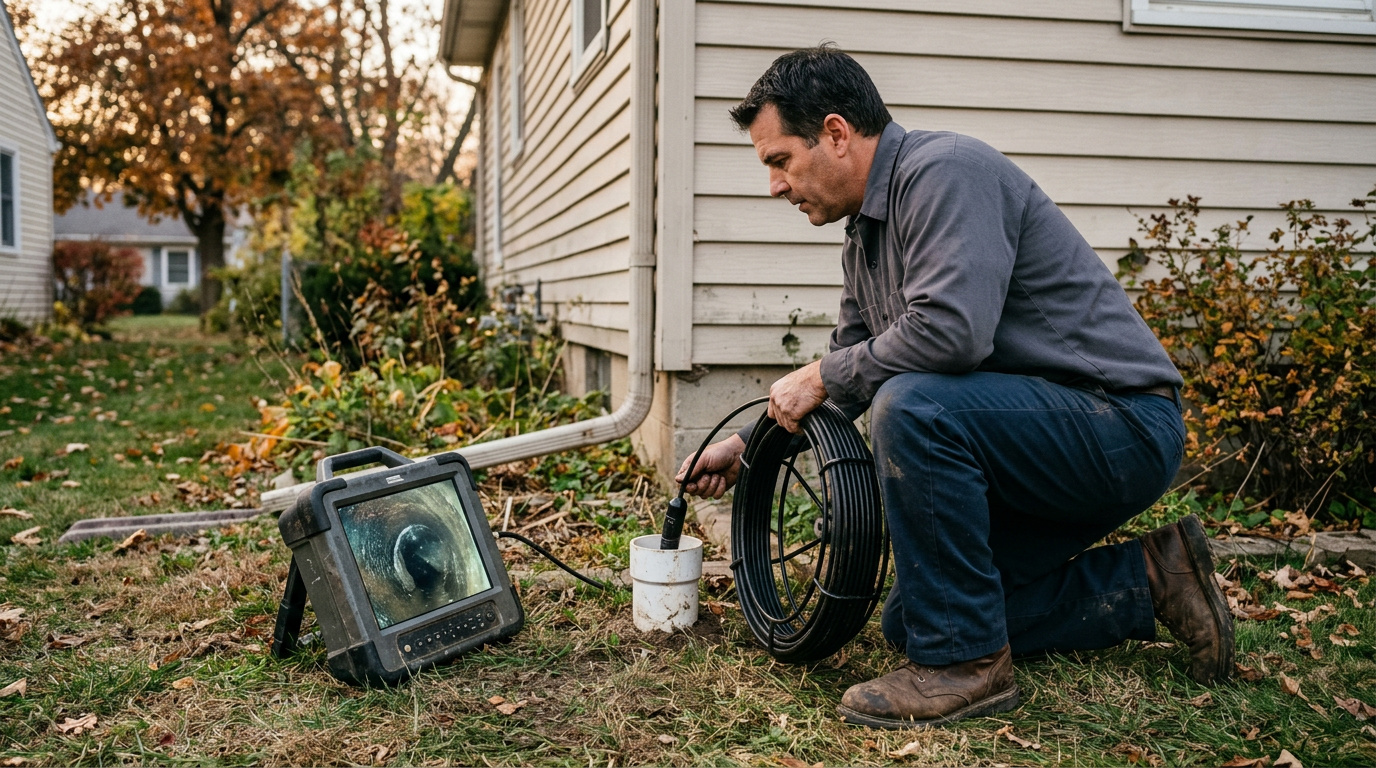
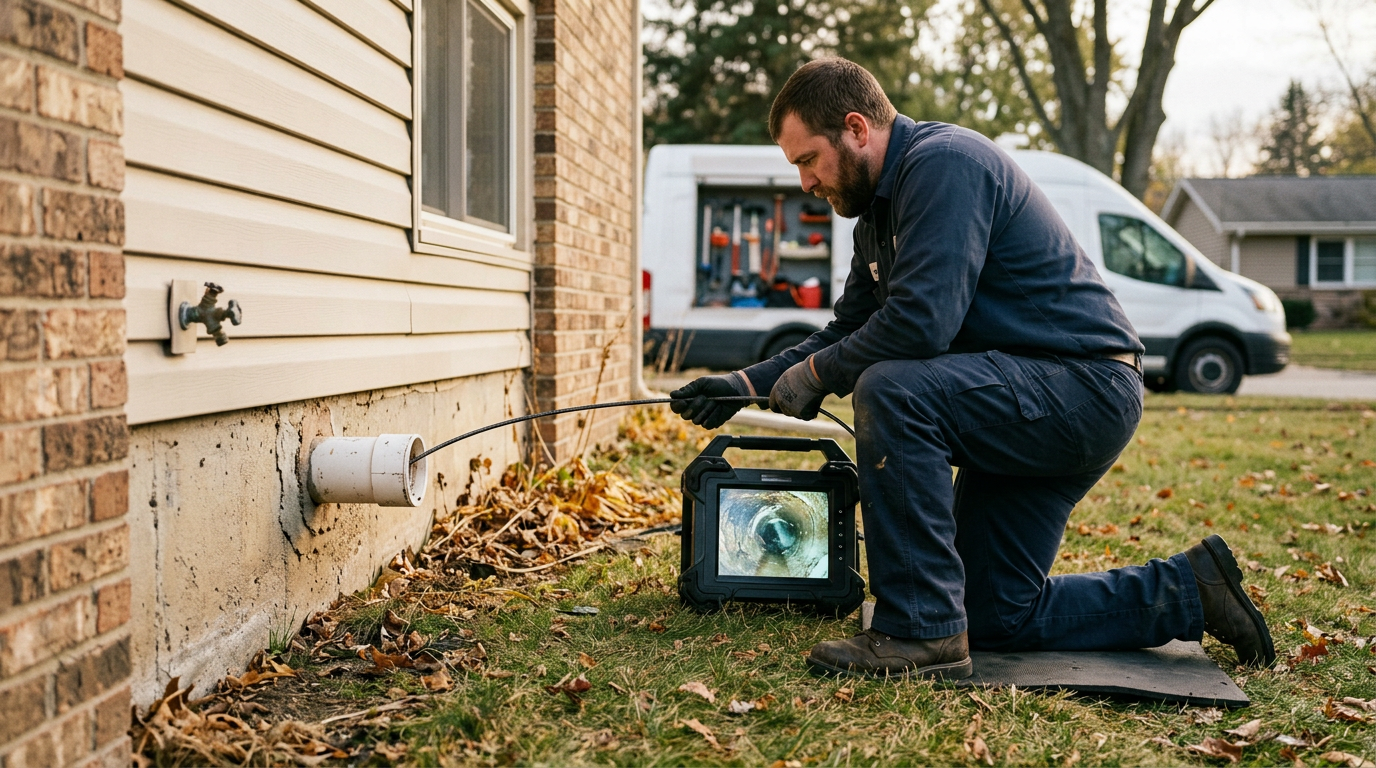
A waterproof camera head rides the end of a flexible glass-fiber cable, travels down the line, and streams live video to a monitor while a counter on the reel tracks how far that head has gone. That is the mechanism behind a camera inspection: light, lens, cable, and a distance readout. Nothing gets dug up to find out what is wrong.
The run starts at an access point. We look for a cleanout first, since it gives the shortest straight path into the main line. When a cleanout is missing, damaged, or plugged below the cap, the cable can go in through a toilet, a main stack opening, or a roof vent instead. It feeds by hand, a few feet at a time, and the operator steers it through bends by feel. The camera head carries its own LED lighting, because the inside of a sewer line is dark at any hour, and a wide-angle lens keeps joints, offsets, and the crown of the pipe in the same frame. Litteken Plumbing treats the recorded video as part of the job rather than an add-on, so you see what the operator sees.
Why Does Cleaning Come Before the Camera?
The camera only reports what the pipe will let it see. Sludge, grease, and standing water hide cracks, offsets, and root intrusions, so a line that was not cleaned first produces video nobody can trust. Municipal inspection specifications make that order explicit: the purpose of the run includes judging how thorough the cleaning was before defects are observed and recorded.
A clean line also makes the report portable. Formal sewer inspections follow the Pipeline Assessment and Certification Program coding system from the National Association of Sewer Service Companies, the trade body whose credential backs the work, and that certifies inspectors to perform inspection of pipelines, and code viewed pipe conditions. Public CCTV specifications require the operator on the cable to hold that credential and to have been certified or re-certified within three years before the job starts, with the certificate filed ahead of the inspection. Ask for it when the inspection feeds a real decision, such as a pre-purchase scope or a repair quote. The same defect should collect the same code and the same recommendation no matter which crew holds the monitor. That consistency is the point of a professional camera inspection.
How Do You Know Where to Dig?
Distance matters as much as the picture. The counter on the reel reads footage traveled from the access point, so a joint the operator puts at 30 feet sits 30 feet from where the cable entered, not somewhere vague under the yard.
The second half of locating happens above ground. The camera head carries a transmitter, and the ground over the line is swept with a receiver while the cable is still in the pipe. Anvilfield’s field guide sums the order up: run the camera, read the defect, then put a sonde on it so the crew knows where the fault sits and how deep it is before anyone cuts sod. That sequence is what keeps a repair small. A marked spot and a measured depth point a dig crew at one narrow hole over the failure, instead of an exploratory trench the length of the yard.
What You Should Walk Away With
- Recorded video of the full cable run, handed over as a digital file or on a standard storage medium
- A written report that names each defect, its condition code, and its distance from the access point
- Confirmation of the operator’s certification when the inspection supports a formal condition assessment
- A plain-language readout of what the video shows, given before anyone quotes a repair
Which Camera Option Fits Your Drain Line?
Compare three ways to find what is wrong with a line before paying for any repair. A camera inspection answers it with a record: the pipe wall is seen, the defect is measured from the access point, and the footage can be coded and kept. Snaking or jetting alone clears the blockage and says nothing about the condition behind it. Newfoundland and Labrador’s public works specification runs its CCTV inspection to record structural and service defects and to verify new sewer construction before acceptance.
The real choice is which setup you use and how much proof you need. A push rod camera, fed by hand through a cleanout, covers most single residential laterals and reaches the defect without a dig. A crawler carries farther on long main runs, deep lines, and commercial pipe where hand feeding stops short. Coding the result matters when a home purchase, a municipality, or an insurer wants documentation rather than an opinion, since coded surveys follow published programs such as NASSCO PACP, LACP, and MACP.
Jetting is the alternative when the line is too cloudy to read. We clean, then look, because a fouled lens proves nothing either way. Litteken Plumbing puts licensed, seasoned professionals on camera and jetting work under License #055-043593. Start with a push rod survey through the cleanout, and add coded documentation only when someone besides you has to sign off on the answer. What a camera will not do is set the repair price. Pricing follows the length of line surveyed and the access needed to reach it.
Inspection option | Where it fits | Access and reach | Published figure or requirement |
|---|---|---|---|
Push rod camera | Single residential laterals and short drain runs | Cleanout entry, with the defect logged in footage measured from that access | Trade field guide [last reviewed Jun 27, 2026] citing 2 code references |
Crawler camera | Long main runs, deep lines, and commercial or municipal pipe | Maintenance hole entry, with footage kept on CD, DVD, flash card, or hard drive | Ontario standard [OPSS.PROV 409], July 2024 edition, requires submittals 10 Business Days before CCTV work starts |
Coded PACP condition survey | Home purchase scopes, utility acceptance, and insurer documentation | Same camera pass, then coded defects and a written report for the record | [Section 02300], revised November 2025, requires each operator to hold a NASSCO certificate from within the three years before the contract starts |
Jetting first, then the camera | Lines too cloudy to read, plus recurring clogs and grease or sludge buildup | High pressure water clears the pipe wall so the lens can actually see it | NASSCO CCTV guideline dated [October 2014] and reissued 2020 pays surveys under Part 5 measurement and payment |
Ready to See What’s Inside Your Line?
Clear the guesswork before you dig. A drain camera inspection service from Litteken Plumbing runs a camera through the line, so you see the blockage, break, or root intrusion on record. Ask how we handle NASSCO certification, so the crew inspecting your drain codes the pipe conditions it views on camera and walks you through them before any repair. Small enough to care, big enough to deliver. Contact our office to book a visit. Contact us today.